Before the Bell Rings: How Everyday Transitions Prepare Young Minds for Learning
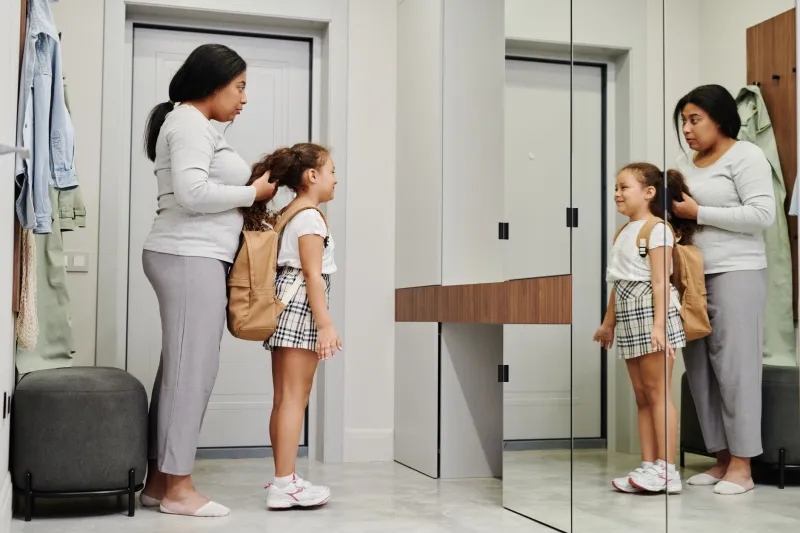
At Marlton School, we spend a great deal of time thinking about what happens inside our classrooms. But educators and researchers increasingly recognize that some of the most formative cognitive work a child does each day happens outside of school hours—often in the most ordinary moments imaginable. The ride in the carpool lane. The walk down the block. The scramble to find a backpack by the front door.
These transitions are not dead time. They are, in a very real sense, a second classroom—one run by families, shaped by routine, and quietly tuning the brain for everything that follows.
The Science of the In-Between
Neuroscientists sometimes describe learning as a process of anticipation and consolidation. The brain does its strongest work not only during an experience, but in the moments just before and just after it. A predictable morning routine lowers cortisol levels associated with stress, freeing up working memory for the day ahead. A calm transition after school gives the mind space to consolidate new information into long-term memory.
In other words, the half hour before school and the hour after it are not neutral. They either prime a child's attention or scatter it. Families who treat these windows as meaningful—rather than as obstacles to rush through—are giving their children a genuine academic advantage.
The Morning Routine as a Cognitive Warm-Up
Consider what a well-structured morning actually teaches. When a child follows a consistent sequence—waking, dressing, eating, organizing materials—they are practicing executive function: the mental toolkit of planning, sequencing, and self-monitoring that underpins success in mathematics, reading comprehension, and independent work.
The good news is that this does not require elaborate systems. Simple, repeated rituals work best:
- A consistent wake-up rhythm. Regular sleep and wake times stabilize attention spans for the entire day.
- A preview conversation. Two minutes at breakfast asking, "What are you looking forward to today? What might be tricky?" builds metacognition—the habit of thinking about one's own thinking.
- Child-owned checklists. A kindergartner who packs her own water bottle and folder is rehearsing responsibility in miniature.
The Commute Is Not Empty Time
Whether your family walks, drives, or takes the bus, the journey to school offers a rare commodity: unstructured, side-by-side time with a caring adult. Unlike a face-to-face dinner conversation, walking or riding together removes the pressure of eye contact, which many children—especially adolescents—find liberating.
Families can use this time in low-stakes ways. Play "one good question" where each person wonders aloud about something they noticed. Narrate the neighborhood: street names, seasonal changes, the math of bus schedules. These small exchanges build vocabulary, curiosity, and a sense of place—foundations that show up later in writing, reading, and civic understanding.
The Walk Home: Where Learning Gets Consolidated
The after-school transition deserves equal attention. When children decompress before homework—through movement, a snack, or simply quiet—the brain has an opportunity to file away the day's lessons. Research on spaced practice suggests that brief periods of rest after learning improve retention significantly.
A useful family habit is the "rose, thorn, bud" check-in: one good thing from the day, one challenge, one thing they are looking forward to. It takes ninety seconds, requires no preparation, and teaches children to reflect rather than merely react to their experiences.
When Routines Fray
No family executes a perfect schedule every day, and perfection is not the goal. What matters is the pattern: a general rhythm children can rely on, even when individual days go sideways. Predictability, not rigidity, is what signals safety to a developing brain.
If mornings are consistently chaotic, simplify rather than add. Fewer steps, laid out the night before, beat elaborate systems that collapse under real-world pressure.
A Partnership Between Home and School
At Marlton School, we see families as co-educators in the fullest sense. The routines you build at home extend and reinforce the work that happens here. When a child arrives having slept well, eaten, and predicted something about their day, our teachers receive a student who is ready—not just present.
The walk to school really is a classroom. It just doesn't have desks.


