Beyond the Report Card: How Marlton School Cultivates the Whole Student for a Complex World
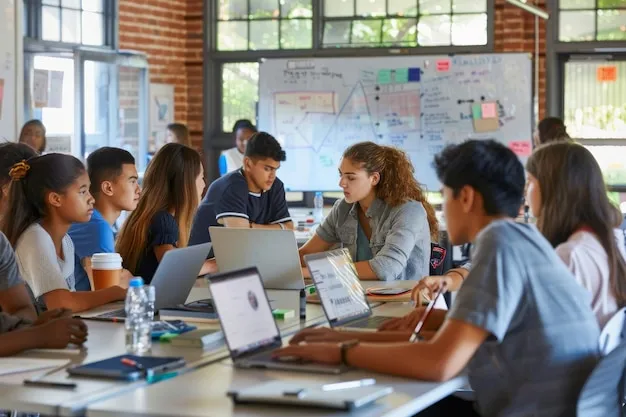
Photo: diverse students collaborating classroom discussion social emotional learning, via teachfind.com
For much of the twentieth century, American education operated under a fairly simple premise: academic performance, measured primarily through grades and standardized assessments, was the clearest indicator of a student's readiness for adult life. A strong GPA opened doors. A high SAT score signaled potential. The rest — how a young person handled conflict, navigated disappointment, or collaborated with others who held different viewpoints — was largely considered a private matter, something families addressed at home.
That framework has been under serious revision for some time now, and the revision is accelerating.
A Shifting Definition of Readiness
A 2023 survey conducted by the National Association of Colleges and Employers found that the attributes employers most consistently prioritize when evaluating recent graduates include critical thinking, communication, teamwork, and professionalism — competencies that are deeply rooted in social and emotional development. Technical knowledge and academic credentials remain important, but they are increasingly viewed as baseline qualifications rather than differentiating factors.
University admissions offices have undergone a parallel shift. The Coalition for College has advocated for holistic review processes that examine how students have grown, how they have contributed to their communities, and how they have responded to adversity. Many selective institutions now explicitly evaluate what they describe as personal qualities — curiosity, resilience, integrity — alongside traditional academic indicators.
The implication for schools is significant: preparing students for life after graduation requires attending to dimensions of development that transcend the curriculum.
What Social-Emotional Learning Actually Means
Social-emotional learning, commonly referred to as SEL, is a term that has gained considerable currency in educational discourse. Like many such terms, it risks becoming diluted through overuse. At its core, however, SEL refers to the process through which students develop five interconnected competencies, as defined by the Collaborative for Academic, Social, and Emotional Learning (CASEL): self-awareness, self-management, social awareness, relationship skills, and responsible decision-making.
These are not soft skills in the dismissive sense that phrase is sometimes intended. They are demanding capacities that require deliberate cultivation, consistent practice, and thoughtful adult guidance. A student who can regulate their emotions under pressure, empathize with a peer who holds a different perspective, and make principled choices in ambiguous situations has developed something genuinely difficult and genuinely valuable.
At Marlton School, these competencies are not treated as supplemental to the academic mission. They are integral to it.
Integration, Not Addition
One of the most common misconceptions about SEL is that it requires carving out separate time in an already full school day — a weekly assembly, a standalone class, a periodic workshop. While structured programming has its place, the most effective approach embeds social-emotional development into the ordinary flow of school life.
At Marlton School, this integration is visible across multiple contexts. In language arts classes, students engage with literature not merely as a vehicle for analyzing narrative structure but as an opportunity to explore moral complexity, consider perspectives unlike their own, and articulate their emotional responses to challenging themes. A character's decision in a novel becomes a springboard for examining how students themselves might navigate similar pressures.
In science and mathematics, collaborative problem-solving is designed to require genuine interdependence. Students must listen to one another, negotiate approaches, and manage the frustration that accompanies difficulty. These are not incidental outcomes of group work — they are deliberate instructional goals, and teachers are trained to name and discuss them explicitly.
"We talk openly with students about what it feels like to be stuck on a problem and not know the answer," notes one Marlton educator. "We normalize that discomfort and then practice strategies for moving through it. That's a skill they will use for the rest of their lives, in every professional and personal context they encounter."
Conflict as a Learning Opportunity
No school community is free of disagreement, misunderstanding, or interpersonal friction. What distinguishes institutions that prioritize SEL is not the absence of conflict but the presence of structured, consistent approaches to working through it.
Marlton School employs restorative practices as a central component of its community culture. Rather than relying exclusively on punitive responses to behavioral issues, restorative approaches ask students to reflect on the impact of their actions, engage in dialogue with those affected, and participate actively in repairing relationships. This process is more demanding than a simple consequence — and considerably more instructive.
Students who move through restorative processes develop capacities for accountability and repair that are directly transferable to adult relationships and professional environments. They learn that mistakes are not simply violations to be punished but opportunities to understand themselves and others more fully.
Building Resilience Before It Is Urgently Needed
Resilience — the ability to recover from setbacks, adapt to changing circumstances, and maintain a sense of agency in the face of difficulty — has become one of the most discussed qualities in conversations about student well-being. It is also one of the most misunderstood.
Resilience is not a fixed trait that some children possess and others lack. It is a skill set developed through experience, supported by relationships, and strengthened through reflection. Students do not become resilient by being shielded from challenge; they become resilient by encountering appropriate challenges within environments that provide both adequate support and the expectation that they can persevere.
At Marlton School, academic rigor and emotional support are understood as complementary rather than competing. Challenging coursework is paired with explicit instruction in how to approach difficulty — how to seek help effectively, how to break large problems into manageable components, how to maintain perspective when progress feels slow. Advisors and counselors maintain regular contact with students, not only during moments of crisis but as a consistent presence throughout the school year.
What Families Can Do at Home
The research on SEL is clear on one point that families should find encouraging: the competencies cultivated in school are powerfully reinforced by what happens at home. Parents and guardians who model emotional vocabulary — naming their own feelings accurately and discussing them openly — provide children with a framework for doing the same.
Families can also support SEL development by resisting the impulse to resolve every difficulty on a child's behalf. Allowing young people to navigate frustration, negotiate with peers, and work through disagreement with appropriate guidance rather than immediate intervention builds exactly the kind of internal resources that formal SEL instruction aims to develop.
Marlton School's family resources are designed to extend this partnership. Workshops, informational sessions, and direct communication with advisors ensure that families have the language and the tools to reinforce at home what students are practicing at school.
The Longer View
A student who graduates from Marlton School having mastered calculus but lacking the ability to collaborate under pressure, manage their own anxiety, or respond to failure with equanimity is not fully prepared for what awaits them. Conversely, a student who has developed genuine emotional intelligence alongside a strong academic foundation is equipped to navigate an adult world of considerable complexity and uncertainty.
At Marlton School, the conviction is that these goals reinforce one another — that students who feel known, supported, and emotionally grounded are more capable learners, and that students who are genuinely challenged academically develop character through that challenge. The report card matters. It is simply not the whole story.