Where History Meets Science Meets Literature: Inside Marlton's Integrated Classroom
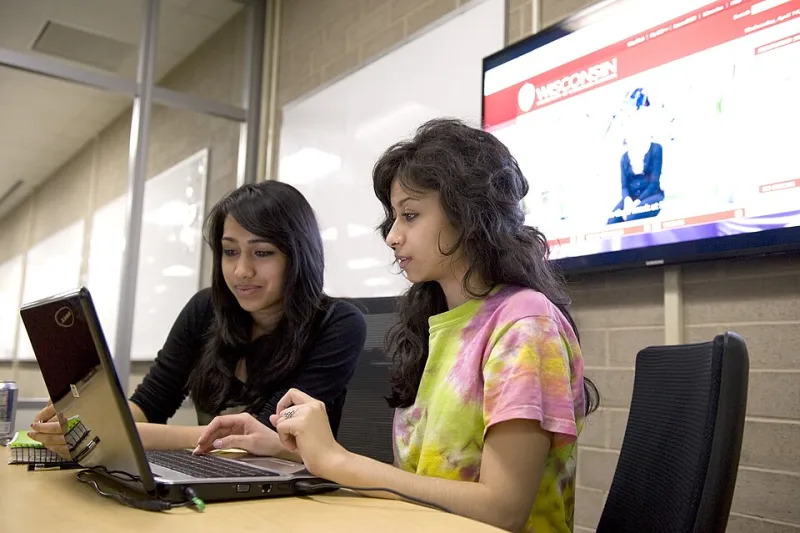
Photo: college.library, CC BY 2.0, via Wikimedia Commons
Most students have experienced the jarring transition of a school day divided into neat, separate blocks: forty minutes of history, then a bell, then forty minutes of biology, then another bell. Each subject exists in its own container, sealed off from the others. It is an efficient system—but efficiency and depth are not always the same thing.
At Marlton School, educators have deliberately challenged this model. Rather than treating academic disciplines as isolated territories, the faculty designs learning experiences that allow subjects to inform and enrich one another. The result is a curriculum that reflects how knowledge actually works: not in silos, but in conversation.
The Problem With Compartmentalized Learning
Consider how a student might study the Industrial Revolution in a traditional school setting. In history class, they learn about factory conditions and labor reform. In a separate science class, they examine the mechanics of the steam engine. In English, they might read a Dickens novel set in Victorian England—but rarely is the connection between these three experiences made explicit.
The opportunity cost of that missed connection is significant. Research in cognitive science consistently demonstrates that students retain information more effectively and apply it more flexibly when they understand how concepts relate to one another. When a student recognizes that the same era that produced coal-powered factories also produced Hard Times and transformed urban public health, they are not simply accumulating facts—they are constructing a mental framework for understanding cause and effect, systems thinking, and human consequence.
That framework is precisely what interdisciplinary learning is designed to build.
How Integration Works at Marlton School
Interdisciplinary learning at Marlton is not a supplementary activity or an occasional special project. It is embedded into the fabric of how courses are structured and how teachers collaborate.
Faculty members across departments meet regularly to identify thematic convergence points—moments where the content they are teaching intersects in meaningful ways. These conversations lead to coordinated units in which students encounter the same theme, era, or problem from multiple academic vantage points simultaneously.
One example from the upper school involves a multi-week unit centered on the concept of adaptation. Students examine biological adaptation in science class, exploring how organisms respond to environmental pressures over generations. Concurrently, in social studies, they analyze how human civilizations have adapted to geographic constraints—how the availability of water, arable land, and natural resources shaped the development of ancient societies. In their literature coursework, they engage with narratives in which characters must adapt to circumstances beyond their control, examining resilience and transformation as literary themes.
By the end of the unit, students are not simply answering questions about biology, history, or fiction in isolation. They are drawing connections across all three, constructing arguments that weave evidence from multiple disciplines into a single, coherent analysis.
Real Projects, Real Connections
Project-based learning serves as one of the primary vehicles for interdisciplinary work at Marlton. These extended assignments ask students to investigate a central question that cannot be answered through any single subject area alone.
A recent project in the middle school asked students to examine the ethics and science of water access—a topic that intersects environmental science, civics, geography, and persuasive writing. Student teams researched the chemistry of water purification, mapped regions of the world experiencing scarcity, studied the policy frameworks governing water rights in the United States, and ultimately presented proposals to a panel of teachers and community members. The presentations required students to synthesize technical data with ethical reasoning and communicate their findings with clarity and conviction.
This kind of work does more than deepen content knowledge. It mirrors the actual conditions under which professionals in every field operate. Engineers consult ethicists. Policymakers rely on scientists. Writers draw on history. The ability to move fluidly between disciplines is not a luxury skill—it is a prerequisite for meaningful participation in a complex world.
The Teacher's Role in an Integrated Curriculum
Interdisciplinary learning places considerable demands on educators. It requires not only mastery of one's own subject area but also genuine curiosity about—and respect for—the expertise of colleagues in other departments.
Marlton School invests in the professional development and collaborative planning time that makes this possible. Teachers are not asked to become generalists; they remain specialists in their disciplines. However, they are expected to look outward, to identify the moments where their content can serve as a bridge rather than a boundary.
This culture of intellectual collaboration among faculty is visible to students. When they observe their history teacher and science teacher discussing a shared project with evident enthusiasm, they receive an implicit message: knowledge is not divided by department, and curiosity does not respect the constraints of a bell schedule.
Critical Thinking as the True Outcome
When families ask what students gain from an interdisciplinary education, the most honest answer is not a specific body of content knowledge. It is a habit of mind.
Students who have been trained to seek connections across disciplines approach new problems with a fundamentally different posture. They ask not only what they know, but how what they know in one area might illuminate something in another. They are comfortable with complexity and ambiguity, because their education has consistently presented them with questions that resist simple, single-subject answers.
These are the students who enter college prepared not merely to absorb information in lectures, but to synthesize it—to write papers, lead discussions, and pursue research that reflects genuine intellectual integration.
An Education That Reflects the Real World
The world outside the classroom does not announce itself in discrete subject areas. Climate change is a scientific, political, economic, and humanitarian challenge simultaneously. Public health crises involve biology, sociology, ethics, and policy in equal measure. The careers that students will build—many of which do not yet exist—will require them to operate at the intersections of disciplines, not safely within any single one.
At Marlton School, interdisciplinary learning is not a pedagogical trend. It is a deliberate and sustained commitment to preparing students for the actual complexity they will encounter. By designing a curriculum in which subjects speak to one another, Marlton equips students with something more durable than any single lesson: the capacity to think in connections.
Families interested in learning more about Marlton's academic programs and curriculum design are encouraged to visit marltonschool.org or contact the admissions office to schedule a campus visit.