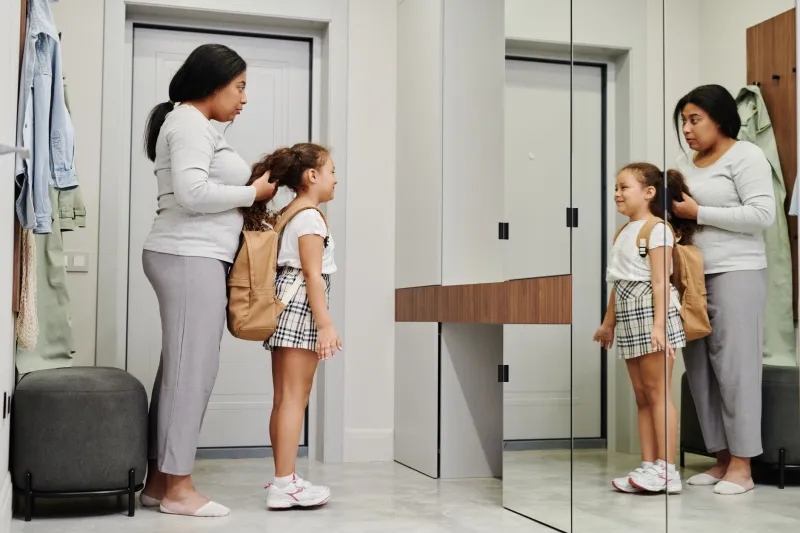
Fifteen Minutes That Matter: Rethinking the Morning Handoff at School
Photo: Heron5110, CC BY-SA 4.0, via Wikimedia Commons
For many American families, the morning drop-off is a carefully choreographed race against the clock. Backpacks are grabbed, lunches are handed through car doors, and goodbyes are shouted over idling engines. It is easy to assume that what happens in those final few minutes is incidental—mere logistics before the real work of the school day begins.
A growing body of developmental research suggests otherwise. The way a child separates from a caregiver in the morning can shape emotional regulation, classroom engagement, and even the capacity to persist through academic challenges hours later. At Marlton School, we view the morning transition not as an ending but as a handoff—one that deserves the same intentionality we bring to curriculum and instruction.
Why Separation Is a Developmental Event, Not a Routine
Attachment researchers have long observed that children use their caregivers as a "secure base"—a psychological anchor from which they explore the world. The morning goodbye is, in effect, a daily rehearsal of this dynamic. When a child experiences a predictable, warm separation, the brain receives a quiet but powerful message: the people I love are steady, and I am safe to venture forward.
Neuroscientists sometimes describe this as the difference between a nervous system that is braced and one that is open. A child who bolts from the car after a tense exchange may arrive at their desk still physiologically activated, spending the first portion of the school day settling rather than learning. A child who leaves after thirty seconds of genuine connection—eye contact, a familiar phrase, a shared joke—arrives primed for engagement.
The implications are modest but meaningful. We are not suggesting that a rushed goodbye causes lasting harm; children are remarkably resilient, and no parent should carry guilt over a hectic Tuesday. Rather, the research suggests that consistency of connection matters more than duration. A brief but reliable ritual can do more for a child's sense of security than an inconsistent hour.
What Fifteen Minutes of Presence Actually Looks Like
The phrase "parent presence" can sound daunting to families juggling commutes, multiple children, and rigid work schedules. In practice, meaningful presence at drop-off requires far less time than most parents imagine. Consider the following practices, drawn from both research and the observations of our own faculty:
- Arrive ten minutes early, once or twice a week. A slower pace in the parking lot or at the school entrance signals to a child that the transition belongs to them, not to the clock.
- Establish a goodbye ritual. A specific phrase, handshake, or even a family "code word" gives the separation a predictable shape. Predictability is what soothes; novelty is what strains.
- Name the reunion, not just the goodbye. Saying "I'll hear all about your science lab at dinner" extends the connection forward, giving the child something to carry through the day.
- Manage your own transition. Children are keen readers of adult stress. A parent who takes one deep breath before the goodbye often changes the emotional temperature of the entire exchange.
None of these require professional development or special resources. They require only the decision to treat the handoff as an event worth doing deliberately.
The Working Parent's Dilemma
It would be dishonest to write about morning routines without acknowledging the realities of American work life. Many parents at Marlton School and across the country face shifts that begin before the school bell, or commutes that make lingering at the curb impossible. The last thing a family resource should do is add another obligation to an overburdened schedule.
Our guidance, therefore, is grounded in flexibility. Presence is a quality, not a quantity. A parent who cannot stay fifteen minutes can still create a moment of connection: a note tucked into a lunchbox, a text waiting on a middle schooler's phone at recess, a two-sentence ritual repeated at the crosswalk. What matters to the child is the pattern of reliability, not the stopwatch.
Families who share drop-off duties—grandparents, neighbors, carpool partners—can coordinate rituals as well. Consistency across caregivers is what builds the secure base; any trusted adult can anchor the transition when the ritual is shared.
How Marlton School Partners With Families in the Transition
Schools bear responsibility here, too. A drop-off experience shaped by long lines, honking traffic, and distracted staff undermines even the most careful family rituals. That is why Marlton School has treated arrival as part of the educational day rather than a precursor to it.
Our faculty greet students by name at the entrance, a practice grounded in the simple research finding that being seen and acknowledged lowers the social barrier to entering a classroom. Homeroom teachers begin the day with brief, low-stakes routines—morning meetings, a shared reading, a moment of quiet—designed to help students complete the emotional transition from home to school. For students who arrive visibly unsettled, our staff are trained to offer a soft landing rather than an immediate academic demand.
We also communicate with families. If a child's mornings appear consistently difficult, our teachers see it as information worth sharing—not as a critique of home life, but as an invitation to solve the puzzle together. Education, in our view, is a partnership that begins at the schoolhouse door.
A Small Investment With Compounding Returns
There is a temptation, in conversations about academic success, to focus on the visible levers: tutoring, test preparation, advanced coursework. Yet the conditions under which a child learns—their sense of safety, belonging, and connection—are the substrate on which all of those levers operate. The morning handoff is one of the few points in the day where families can directly influence those conditions, in under a quarter of an hour, at no cost.
We encourage every Marlton family to experiment: choose one morning this week, arrive a little early, and let the goodbye take its time. Observe what changes—not just in the moment, but in what your child brings home at the end of the day. Small rituals, repeated with care, are how children learn that school is not a place they are sent, but a place they are welcomed.