More Than a Password: Helping Students Understand Who They Are Becoming Online
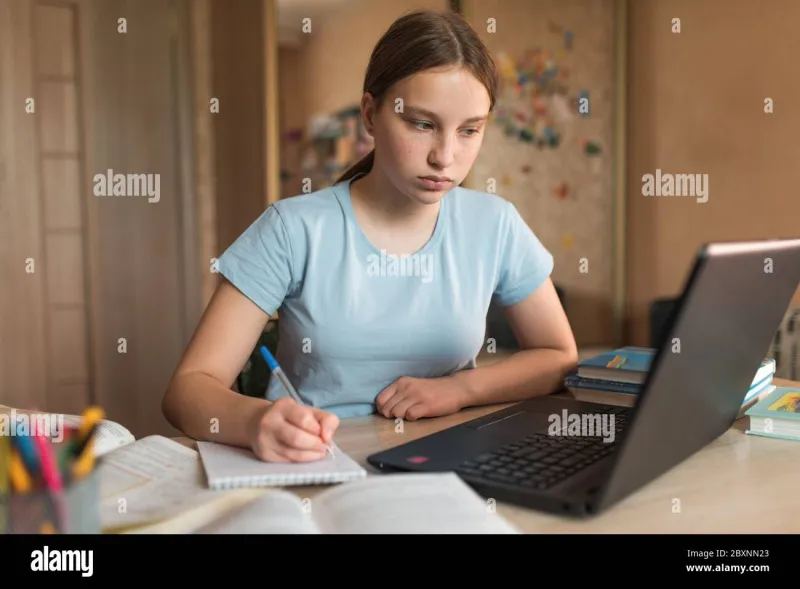
Photo: teenager thoughtfully using laptop computer at home digital learning, via c8.alamy.com
For years, the conversation about students and the internet centered on a familiar set of warnings: do not share your personal information, be careful with strangers, use a strong password. These remain valid pieces of advice. But as a generation of young people grows up with social media profiles, collaborative digital tools, and a permanent record of their online activity, the guidance they need has grown considerably more sophisticated.
The question facing educators and parents today is not simply how to keep children safe from the internet. It is how to help them understand that every click, comment, post, and share is a small act of self-authorship—and that the person they are constructing online is, in many meaningful ways, the person the world will come to know.
Why Traditional Internet Safety Falls Short
Conventional digital citizenship curricula tend to focus on compliance: here are the rules, here are the consequences for breaking them, here is what not to do. This approach has real value for younger children who are still developing impulse control and need clear guardrails. But for middle and high school students, a rules-based framework is insufficient on its own.
Adolescence is precisely the developmental stage at which young people are working out questions of identity, autonomy, and social belonging. They are not simply looking for rules to follow—they are looking for frameworks that help them make sense of who they are and who they want to be. Digital citizenship education that speaks to those deeper questions is far more likely to influence actual behavior than a list of prohibitions.
Researchers at the Harvard Graduate School of Education, through initiatives like the Good Project, have argued that effective digital citizenship education must engage students' moral reasoning, not just their awareness of risk. Students who understand why certain online choices matter—not just that they are against the rules—develop the internal compass that guides decision-making in situations no teacher or parent anticipated.
The Digital Footprint as a Living Document
One of the most powerful concepts educators can introduce is the idea of the digital footprint as something active and ongoing rather than abstract and theoretical. Every student who has applied for a competitive internship, college program, or scholarship has encountered the reality that admissions officers and employers routinely search applicants online. What they find—or do not find—shapes perceptions in ways that a single interview rarely can.
But the conversation should extend beyond reputation management. Students benefit from understanding that their digital history also shapes their own self-perception over time. The comments they post in frustration, the images they share impulsively, the communities they affiliate with publicly—these choices accumulate into a narrative. Teaching students to periodically audit their own online presence, asking themselves whether it reflects the person they genuinely aspire to be, encourages a reflective habit that serves them well throughout their lives.
Teaching Critical Consumption Alongside Responsible Creation
Digital citizenship is not only about what students put online—it is equally about how they receive and interpret what others create. In an information environment characterized by algorithmic curation, sponsored content, and deliberately misleading material, the ability to evaluate sources critically is an essential academic skill.
At Marlton School, media literacy is woven into academic programming rather than treated as a stand-alone unit. When students learn to ask who produced a piece of content, what purpose it serves, whose perspective it reflects, and what evidence supports its claims, they are applying the same analytical framework that strengthens their work in history, science, and literature. The skills are transferable because the underlying intellectual habits are the same.
Practical classroom exercises can make this concrete. Having students trace a viral story back to its original source, compare coverage of the same event across outlets with different editorial perspectives, or identify the markers that distinguish a peer-reviewed study from an opinion piece builds the kind of discernment that no single lesson can convey but sustained practice can develop.
Raising Thoughtful Creators, Not Just Cautious Consumers
Many students are already creating digital content—through social media, school projects, community platforms, and personal channels—whether or not their schools have explicitly addressed what it means to do so responsibly. Educators have an opportunity to meet students where they are and help them approach that creative work with greater intentionality.
This means discussing questions like: What is the purpose of what you are sharing? Who is your audience, and does your content serve them well? Are you representing others fairly and accurately? What are the potential consequences—positive and negative—of putting this into the world?
These are not rhetorical questions. They are the same questions that professional journalists, filmmakers, and communicators of all kinds ask as a matter of course. Introducing them in an educational context helps students understand that thoughtful digital creation is a skill with genuine standards, not simply a matter of personal preference.
How Families Can Reinforce These Values at Home
Schools can lay important groundwork, but the conversations that happen at home are often the ones that stick. Families do not need to be technology experts to have meaningful discussions about digital life. What matters most is consistent, curious engagement.
Make it a conversation, not a lecture. Ask your child to show you something they have created or shared online recently, and respond with genuine interest before raising any concerns. When students feel that their digital world is being met with curiosity rather than suspicion, they are more likely to invite you into it.
Talk about your own digital choices. Share how you decide what to post on social media, how you evaluate news stories before sharing them, or how you think about your own professional online presence. Modeling thoughtful behavior is more instructive than any rule you could impose.
Discuss real examples together. When a public figure faces consequences for old social media posts, or when a story goes viral based on misleading information, use that moment as a starting point for genuine reflection. Ask your child what they think, and listen to their reasoning before offering your own perspective.
Create space for mistakes. Students who know that a digital misstep will result in extreme punishment are less likely to come to their parents when something goes wrong online. Maintaining an atmosphere in which errors can be acknowledged and discussed—rather than hidden—is one of the most protective things a family can do.
The Long View
The goal of digital citizenship education, at its most ambitious, is not to produce students who avoid trouble online. It is to produce students who approach their digital lives with the same thoughtfulness, integrity, and self-awareness they bring—or aspire to bring—to the rest of their conduct.
That is a high standard. It is also an achievable one, when schools and families work in partnership to make it a sustained priority rather than a one-time conversation. The students who emerge from that kind of education are not just safer online. They are more capable thinkers, more intentional communicators, and more reflective human beings—qualities that serve them in every dimension of the lives they are building.