Lessons in the Sandbox: Why the Moments Between Classes May Matter Most
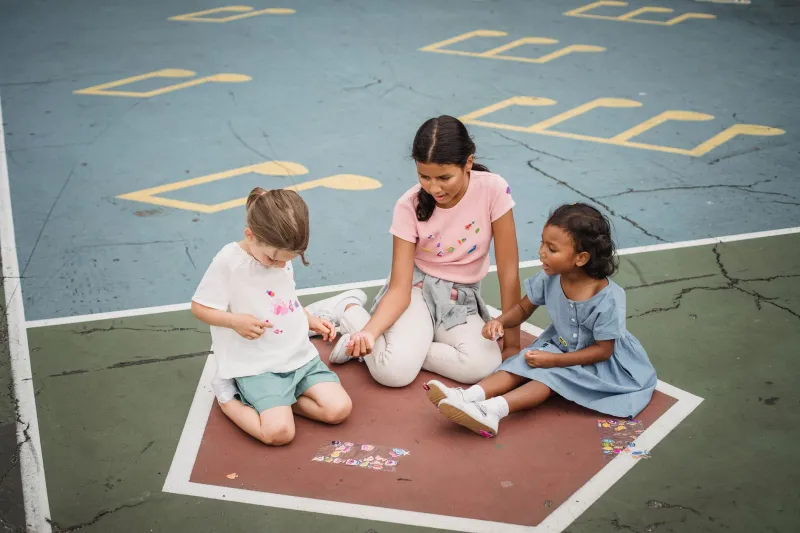
Ask a child about the best part of the school day, and the answer rarely involves a worksheet. More often, it is the twenty minutes spent on the playground — negotiating turns on the swings, inventing rules for a game of four square, or navigating the delicate politics of who sits where at the bench. Adults tend to dismiss these moments as downtime. The evidence tells a different story.
The Case for Unstructured Time
Researchers who study child development have long observed that play is not the opposite of learning; it is one of its primary engines. During unstructured play, children practice skills that no curriculum can fully replicate: weighing risk, reading social cues, resolving disputes without an adult referee, and adapting rules on the fly when a game begins to fall apart.
Consider what happens when a kickball game dissolves into an argument. Someone must propose a compromise. Someone else must decide whether to accept it. These are not small negotiations — they are early rehearsals for the collaborative problem-solving that employers, colleges, and communities consistently rank among the most valuable capabilities a person can possess.
What the Research Shows
The American Academy of Pediatrics has formally recognized recess as a necessary component of the school day, noting that children demonstrate improved attention, memory, and classroom behavior when given regular opportunities for free play. Studies of elementary schools across the United States have found that students who receive at least one daily recess period show stronger on-task behavior in the hours that follow.
The mechanism is straightforward. Sustained concentration is cognitively expensive, particularly for young learners whose executive function is still developing. A period of physical activity and social play appears to reset that capacity, much as a recessed pause helps an adult return to a difficult task with fresh focus.
There is also a quieter benefit. The playground is one of the few settings at school where children direct their own agendas. In a structured classroom, an adult sets the goals. On the blacktop, the children do. That shift — from following instructions to generating them — is where self-direction takes root.
What Parents Can Watch For
Families do not need to become playground monitors to support this dimension of learning. A few practical steps go a long way:
- Ask specific questions. Rather than "How was school?" try "What did you play at recess today?" or "Did anything happen at the blacktop that surprised you?" These questions signal that this part of the day matters.
- Resist over-scheduling. A calendar filled with adult-directed activities can crowd out the self-directed play that builds independence. Unstructured time is not empty time.
- Let children resolve their own conflicts. When a disagreement arises with a friend, the instinct to intervene is strong. Often, the more valuable move is to listen, then ask, "What do you think you'll do?"
- Advocate at school. Parents who want to protect recess time can attend board meetings, review district wellness policies, and ask administrators how daily play is scheduled and supervised.
A Balanced View
None of this argues against structure. Children thrive on predictability, and direct instruction remains essential to academic progress. The point is proportion. A school day that treats play as an expendable luxury misreads how young minds actually develop. The child negotiating the rules of a made-up game is not taking a break from becoming a capable adult — the child is mid-process.
At Marlton School, we believe the hours between the first bell and the last are best understood as a whole. The classroom and the playground are not competing priorities. They are partners in the same project: raising children who can think for themselves, work with others, and meet an unpredictable world with confidence.
The next time your child comes home with a scraped knee and a complicated story about a game that almost didn't happen, you may be looking at the day's most important lesson — delivered in the place no one thought to look.