What No Test Can Measure: The Lifelong Power of Learning to Work With Others
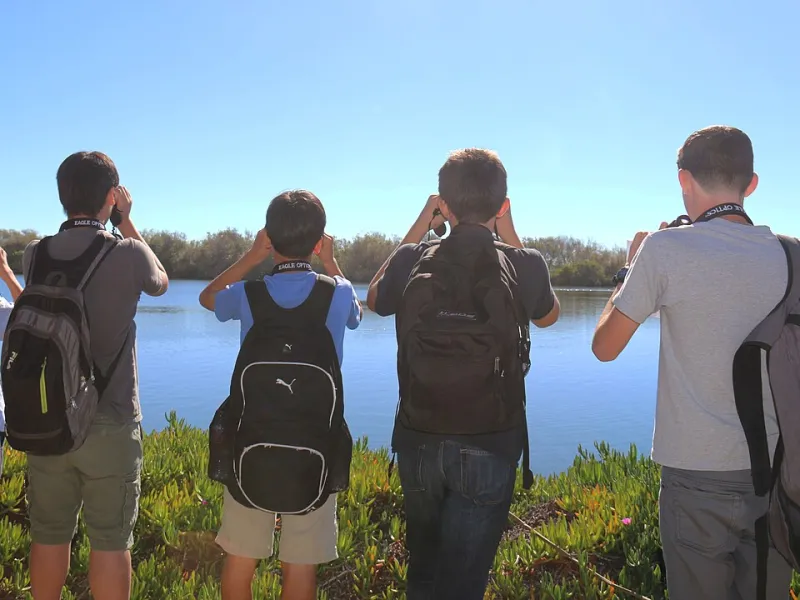
Photo: Ashley Spratt, photographer, US Fish and Wildlife Service. Pacific Southwest Region USFWS from Sacramento, US, Public domain, via Wikimedia Commons
Every parent has watched it happen. A child who earns near-perfect scores on individual assignments suddenly finds themselves frustrated, uncertain, or even withdrawn when asked to complete a project as part of a team. It is not a reflection of intelligence. It is, rather, a signal that a different and equally important set of skills is being called upon—skills that no multiple-choice exam has ever been designed to assess.
At Marlton School, we believe that preparing students for meaningful futures requires more than cultivating individual excellence. It requires teaching young people how to think alongside others, navigate disagreement productively, and contribute to something larger than themselves. Collaborative learning is not a break from serious academic work. It is serious academic work.
What the Research Actually Tells Us
Decades of educational research support what many teachers have observed intuitively: students who engage in well-structured peer collaboration develop deeper conceptual understanding than those who work exclusively on their own. A landmark body of work from researchers at the University of Minnesota found that cooperative learning consistently outperforms both competitive and individualistic learning structures across subjects, grade levels, and demographic groups.
The mechanism is not mysterious. When students must explain an idea to a peer, defend a position, or reconcile two conflicting approaches, they are forced to engage with material at a higher cognitive level than passive review allows. They encounter gaps in their own understanding that a correct answer on a worksheet might never reveal. They also encounter the thinking of someone whose reasoning process differs from their own—and that encounter, when guided well, is profoundly instructive.
Beyond academic content, collaborative experiences build what researchers and employers alike refer to as interpersonal competencies: the ability to communicate clearly under pressure, to manage conflict without abandoning the goal, to recognize when a teammate's contribution strengthens the whole, and to share credit honestly. These are not soft skills. They are foundational capacities that shape whether a capable individual can function effectively within any organization, community, or relationship.
Inside a Marlton Collaborative Classroom
Visit a Marlton classroom during a project cycle and you will notice something that distinguishes our approach from simple group work: structure. Unguided group assignments can inadvertently reinforce inequality, allowing some students to carry the load while others disengage. At Marlton, collaborative projects are designed with deliberate role assignments, staged checkpoints, and reflective components that hold every participant accountable for both process and outcome.
In one recent middle school science unit, student teams were tasked with designing a proposal for reducing food waste in a hypothetical school district. Each team member held a defined role—researcher, data analyst, community liaison, and presentation lead—that rotated across phases of the project. Students were not simply dividing tasks; they were required to teach one another what they had learned in their respective roles before the team could advance.
What emerged was striking. Students who rarely volunteered in whole-class discussions became confident advocates for their findings when presenting to their peers. Students who excelled at independent research discovered that translating technical information for a general audience required an entirely different kind of intellectual effort. And nearly every team encountered at least one genuine disagreement about direction or methodology—disagreements that teachers used as teachable moments in constructive dialogue rather than occasions for adult intervention.
That productive friction is, in many ways, the point.
Why Group Work Feels Hard—and Why That Matters
Parents sometimes contact us with concerns when their child finds a group project frustrating. A teammate is not contributing equally. The group cannot agree on an approach. Their child feels that working alone would be faster and better. These frustrations are real, and they deserve acknowledgment.
They are also, arguably, the most valuable part of the experience.
The workplace your child will enter does not sort people into solo performers and team players. It asks individuals to be both, often simultaneously, and often under conditions they did not choose. Cross-functional teams in virtually every professional field—medicine, engineering, education, business, public service—require people who can integrate their individual expertise with the perspectives of colleagues whose training, priorities, and communication styles differ from their own.
Learning to navigate that complexity at twelve or fourteen, within a supportive school environment where mistakes carry low stakes, is a remarkable advantage. The student who learns to say, "I see your point, and here is where I think we need to push back," in a seventh-grade project is developing a professional competency that many adults still struggle to exercise gracefully.
How Families Can Support Collaborative Learning at Home
Parents play a meaningful role in shaping how their children interpret the experience of group work. A few research-informed approaches can make a significant difference.
Reframe frustration as information. When your child comes home upset about a group dynamic, resist the impulse to validate every complaint uncritically. Ask questions that help them examine their own role: What did you contribute to solving the problem? Was there a moment you could have communicated differently? This is not about dismissing their experience—it is about helping them develop the reflective capacity that collaboration requires.
Celebrate process, not just product. Ask your child not only how the project turned out, but how the team functioned. What did they learn about working with that particular group of people? What would they do differently? Treating the interpersonal process as worthy of attention reinforces the message that how we work together matters as much as what we produce.
Avoid rescue instincts. It can be tempting to step in and help resolve a group conflict or even complete a portion of the work when a team seems to be struggling. In most cases, allowing students to work through difficulty—with teacher guidance at school—produces far more durable learning than a smooth outcome achieved with adult intervention.
A Skill Set for Every Future
Whatever path a Marlton student ultimately pursues—medicine, the arts, entrepreneurship, public service, skilled trades, or fields that do not yet exist—they will work with other people. They will need to earn trust, build consensus, and sometimes lead and sometimes follow. They will need to disagree respectfully and recover from misunderstandings gracefully.
No standardized test will tell you whether your child is developing those capacities. But a well-designed collaborative project, guided by an attentive teacher within a community that values both individual excellence and collective effort, will.
At Marlton School, we design our academic programs to develop the whole range of competencies that a student needs—not only those that appear on transcripts, but those that shape the quality of a life well lived and a career well built. Group projects are not a detour from that mission. They are one of its most direct expressions.