Seeing Through Someone Else's Eyes: How Marlton School Makes Empathy a Core Academic Skill
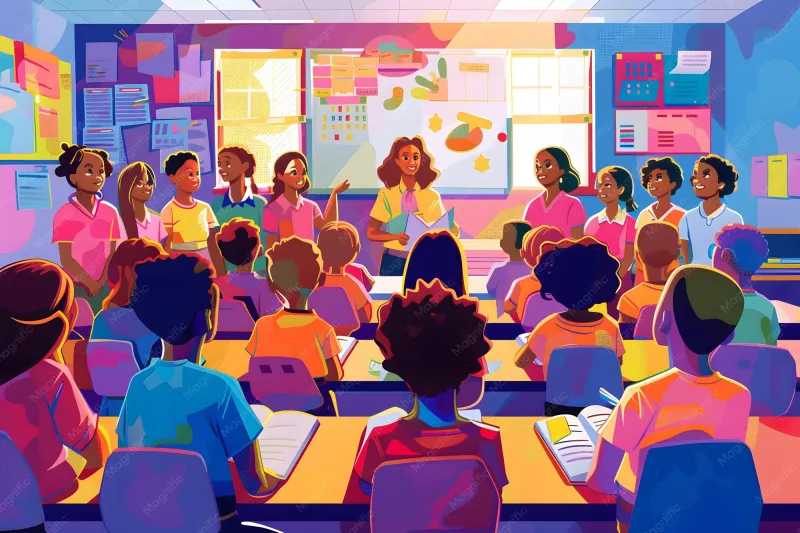
Photo: diverse students engaged in classroom discussion perspective sharing, via img.freepik.com
There is a moment that many Marlton School teachers describe in similar terms. A student is deep in a class discussion — perhaps about a character in a novel, or a historical figure whose choices led to unforeseen consequences — and something shifts. The student stops arguing from their own vantage point and begins, almost visibly, to inhabit another. That moment, educators here will tell you, is not incidental to learning. It is the point of it.
Across American schools, there is growing recognition that academic achievement divorced from human understanding produces graduates who are technically capable but socially incomplete. At Marlton School, the response to this concern is not a standalone program or a single advisory period. It is a deliberate, school-wide commitment to making perspective-taking a rigorous intellectual practice — one that runs through literature, social studies, science ethics, and even mathematics.
What Neuroscience Tells Us About Empathy and Learning
Researchers in developmental psychology and cognitive neuroscience have spent the past two decades mapping what happens in the brain when a person attempts to understand another's internal experience. The findings are instructive for educators. Perspective-taking activates overlapping neural networks associated with both emotional processing and higher-order reasoning — regions of the prefrontal cortex responsible for abstract thought, consequence evaluation, and moral judgment.
Critically, this capacity is not fixed at birth. It is, in the language of neuroscience, plastic — meaning it develops in response to experience and instruction. Studies from institutions including Harvard's Graduate School of Education and the Greater Good Science Center at UC Berkeley consistently show that students who receive structured opportunities to practice empathy demonstrate stronger collaborative skills, reduced incidence of bullying behavior, and greater academic engagement overall.
For Marlton School, this research is not background reading. It is the foundation upon which curriculum decisions are made.
Literature as a Laboratory for Human Understanding
One of the most powerful and accessible tools for developing empathy is also one of the oldest: the act of reading fiction. When a student enters the consciousness of a character whose life circumstances, cultural background, or historical moment differ radically from their own, they are performing a sophisticated cognitive act — one that requires suspending personal assumptions and entertaining an unfamiliar worldview.
In Marlton's English Language Arts classrooms, teachers design discussions specifically to push students beyond plot summary and into genuine perspective analysis. Rather than simply asking what a character did, instructors ask students to reconstruct why — to build a case for a character's reasoning from the inside out, using textual evidence as their foundation. Students are regularly asked to write from a secondary character's point of view, or to compose a journal entry from the perspective of a historical figure whose choices they may find morally complex.
This is not an exercise in excusing poor decisions. It is an exercise in understanding the conditions that produce them — a distinction that matters enormously in developing nuanced thinkers.
Social Studies and the Geography of Other Lives
If literature offers an imaginative entry point into other perspectives, social studies provides a factual one. Marlton School's social studies curriculum is structured around what faculty describe as the geography of other lives — the systematic study of how place, time, economic circumstance, and cultural inheritance shape the way human beings perceive the world and make decisions within it.
In middle school units on American history, for example, students are regularly assigned to research and present the experiences of groups whose voices are frequently marginalized in conventional textbook accounts: Indigenous communities during westward expansion, immigrant families navigating industrialization, women and laborers during periods of significant political change. The goal is not to replace one narrative with another, but to build the intellectual habit of asking whose story is being told — and whose is absent.
In an upper-grade global studies course, students examine contemporary international conflicts through the lens of all primary stakeholders, including those whose positions may be deeply unfamiliar or uncomfortable to a typical American teenager. Faculty report that these units consistently produce the most sophisticated student writing of the academic year, precisely because they demand genuine intellectual effort rather than the rehearsal of familiar positions.
Structured Disagreement as an Empathy Practice
One of the most counterintuitive approaches Marlton School employs is the use of structured disagreement as a tool for empathy development. In classroom debates and Socratic seminars, students are frequently assigned to argue positions they did not choose and may not personally hold. This practice, rooted in classical rhetoric and supported by contemporary research in social cognition, requires students to build the strongest possible case for a viewpoint different from their own.
The results, teachers note, are often transformative. Students who have genuinely worked to construct a compelling argument for an opposing position frequently emerge from the exercise with a more sophisticated understanding of the issue — not because they have changed their minds, but because they have come to understand that the other position has internal logic and human motivation behind it.
This is precisely the skill that is in shortest supply in contemporary American public discourse. The ability to represent an opposing view fairly, accurately, and charitably — what philosophers call the principle of charity — is a discipline, and like all disciplines, it must be taught.
Why This Matters Beyond the Classroom
The practical stakes of empathy education are not abstract. The workforce students will enter in the coming decade is one defined by collaboration across difference — across departments, time zones, cultural backgrounds, and professional disciplines. Employers consistently identify the ability to understand and work effectively with people who think differently as among the most valued and least common qualities in early-career candidates.
Beyond professional life, the civic dimension is equally significant. A democratic society depends on citizens who can engage with perspectives unlike their own without retreating into tribal certainty. The classroom, at its best, is a rehearsal space for that kind of citizenship.
At Marlton School, the conviction is that academic rigor and human development are not competing priorities. They are, in fact, the same priority — and that the student who learns to see through someone else's eyes is not sacrificing intellectual seriousness. They are achieving it.
Building This Capacity Year by Year
Perspective-taking at Marlton is not treated as a skill that can be introduced and checked off. It is understood as a capacity that deepens with scaffolded practice over time. In the earliest grades, teachers use read-alouds and role-play to help young students begin recognizing that other people have thoughts and feelings that differ from their own — a developmental milestone psychologists call theory of mind. In middle school, that foundation supports the more complex analytical work described above. By high school, students are expected to engage with genuinely contested intellectual and ethical questions with both rigor and humility.
This progression is intentional. It reflects Marlton School's understanding that the most important things we teach are not taught in a single lesson. They are built, carefully and consistently, across years of deliberate practice.
In a world that increasingly rewards the capacity to connect across difference, that may be the most future-ready curriculum a school can offer.